
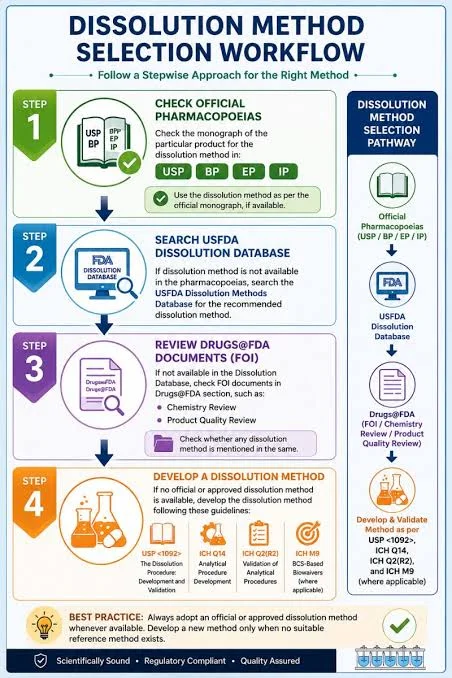
Dissolution Method Development:
Dissolution method development is an important part of pharmaceutical development because it helps us understand how quickly and how completely a drug substance is released from a dosage form. A good dissolution method should not simply produce a passing result; it should provide meaningful information about the performance of the formulation and should be capable of detecting changes in the formulation, manufacturing process, or product quality. In simple words, dissolution testing tells us what happens to a tablet, capsule, suspension, or other dosage form when it comes into contact with a suitable dissolution medium. The development of the method requires a combination of formulation knowledge, API properties, drug release behavior, equipment knowledge, and analytical understanding.
What Is Dissolution Method Development?
Dissolution method development is the systematic process of selecting appropriate dissolution equipment, medium, volume, agitation speed, temperature, sampling time, and analytical conditions to measure drug release from a pharmaceutical dosage form. The objective is to develop a method that is scientifically justified, reproducible, discriminatory, and suitable for routine quality control as well as development studies. During development, the analyst should understand the characteristics of the API and formulation before selecting the final dissolution conditions.
A dissolution method generally consists of several important components, including the dissolution apparatus, dissolution medium, medium volume, temperature, rotation or flow rate, sampling time points, filtration, sample preparation, and quantitative analytical procedure. Every parameter can influence the dissolution profile, so changing one parameter without understanding its effect can sometimes result in a method that is either too harsh or not sufficiently discriminatory.
Step 1: Understand the API and Drug Product
The first step in dissolution method development is to understand the drug substance and dosage form. Important API characteristics include aqueous solubility, pKa, logP or lipophilicity, polymorphic form, particle size, salt form, melting point, and chemical stability. Solubility is particularly important because a poorly soluble drug may require special consideration when selecting the dissolution medium.
The formulation should also be evaluated. For example, a conventional immediate-release tablet behaves differently from an extended-release tablet, enteric-coated tablet, capsule, suspension, or orally disintegrating tablet. Excipients such as polymers, surfactants, binders, disintegrants, lubricants, and coating materials can significantly influence drug release. Therefore, dissolution development should not be performed by considering the API alone.
Step 2: Determine the Purpose of the Dissolution Method
Before starting experiments, clearly define why the dissolution method is being developed. A method developed for formulation screening may need to be more sensitive and discriminatory than a routine QC method. During formulation development, dissolution can be used to compare different formulations, identify critical formulation variables, evaluate manufacturing changes, and understand drug-release behavior.
For a routine release specification, the method should be robust and reproducible. For modified-release products, the objective may be to characterize drug release over several hours and demonstrate that the formulation provides the intended release pattern. Therefore, the purpose of the method influences the experimental design.
Step 3: Select the Dissolution Apparatus
The next step is selecting the appropriate dissolution apparatus. For many immediate-release tablets and capsules, USP Apparatus 1, the basket method, or USP Apparatus 2, the paddle method, are commonly considered. Apparatus 2 is frequently used because it is simple and suitable for many conventional solid oral dosage forms.
However, apparatus selection should be based on the physical characteristics of the dosage form. Capsules may float and therefore may require a suitable sinker when scientifically justified. Tablets that tend to stick to the vessel or paddle may require investigation of alternative conditions.
For certain products, other apparatus may be more appropriate. For example, reciprocating-cylinder systems, flow-through cells, or specialized equipment may be useful for modified-release products, poorly soluble compounds, or dosage forms that present particular hydrodynamic challenges. The selected apparatus should provide meaningful and reproducible drug-release data.
Step 4: Selection of Dissolution Medium
Selection of the dissolution medium is one of the most critical steps in dissolution method development. The medium should provide an appropriate environment for drug release while maintaining adequate drug solubility and stability.
Common dissolution media include purified water, dilute hydrochloric acid, buffer solutions at different pH values, and aqueous media containing surfactants when scientifically justified. The selection should be based on the API’s solubility-pH profile, pKa, formulation characteristics, and intended mechanism of drug release.
For example, if an API has strong pH-dependent solubility, dissolution behavior may change significantly between acidic and near-neutral conditions. In such cases, evaluating multiple pH conditions can provide useful information. For poorly water-soluble drugs, a surfactant may sometimes be required to maintain suitable solubility. However, surfactant should not be added simply to obtain complete release. The concentration should be scientifically justified.
Step 5: Evaluate Drug Solubility in Different Media
Drug solubility studies are extremely useful before finalizing the dissolution medium. The solubility of the API should be evaluated in the proposed media under appropriate conditions.
The purpose is to determine whether the dissolution medium can provide sufficient capacity for the amount of drug being released. If the drug concentration approaches saturation during the test, the resulting dissolution profile may not represent the true release behavior of the dosage form.
This is why sink conditions are important, particularly for poorly soluble drugs. In simple terms, the dissolution medium should have sufficient capacity to dissolve the drug without becoming saturated during the test. Solubility data can therefore guide the selection of pH, buffer concentration, surfactant, and medium volume.
Step 6: Select the Dissolution Medium Volume
After selecting potential media, the appropriate volume should be evaluated. Common dissolution volumes include 500 mL, 900 mL, and 1000 mL, although the appropriate volume depends on the product and apparatus.
The volume should provide sufficient solubility capacity while remaining suitable for the selected apparatus and analytical procedure. A larger volume can sometimes improve sink conditions for poorly soluble compounds, but the objective should not simply be to maximize the volume. The final volume should be scientifically justified and consistent with the intended method.
Step 7: Optimize Agitation Speed
Agitation speed is another important parameter. For Apparatus 2, common speeds may include 50, 75, or 100 rpm, but the appropriate speed depends on the dosage form and product characteristics.
A very low speed may result in incomplete mixing and poor reproducibility, while an excessively high speed can make the method too aggressive and reduce its ability to discriminate between formulations. During development, different speeds should be evaluated to determine how sensitive the dissolution profile is to formulation and process differences.
For example, if 50 rpm produces meaningful discrimination but 100 rpm causes almost complete release from all formulations within a very short period, the lower speed may provide more useful information.
Step 8: Control Dissolution Temperature
Dissolution testing is normally performed at approximately physiological temperature, commonly around 37 ± 0.5°C for conventional oral products. Temperature can significantly influence solubility, viscosity, diffusion, and dissolution rate.
The dissolution medium should therefore be equilibrated to the required temperature before testing. The temperature should also be monitored during the test because deviations can affect results and method reproducibility.
Step 9: Establish Sampling Time Points
Sampling time points should be selected according to the dosage form and purpose of the study. For an immediate-release product, early time points are particularly important because they help determine the initial release rate. Later time points demonstrate whether the product reaches the expected level of drug release.
For example, a development study might evaluate several time points such as 5, 10, 15, 20, 30, 45, and 60 minutes. These are only examples; actual time points should be selected based on the product’s dissolution behavior.
For modified-release products, considerably longer testing may be required. Multiple time points should be selected to adequately characterize the entire release profile.
Step 10: Compare Different Formulations
One of the most valuable uses of dissolution during development is formulation comparison. Different formulations may contain different levels of disintegrant, binder, lubricant, polymer, surfactant, or other excipients.
Dissolution profiles can help determine whether these changes influence drug release. A useful method should be capable of detecting meaningful formulation differences. If every formulation gives approximately 100% release almost immediately, the method may not be sufficiently discriminatory for development purposes.
A discriminatory method does not necessarily mean a slow method. Instead, it means that the method can detect relevant changes in formulation or manufacturing variables while still providing reproducible results.
Step 11: Evaluate Hydrodynamic Behavior
During dissolution development, physical behavior of the dosage form should be carefully observed. Analysts should record whether tablets float, cone, stick to the vessel wall, stick to the paddle, or disintegrate rapidly.
These observations are important because abnormal hydrodynamics can introduce variability. For example, a tablet that repeatedly sticks to the vessel may show a different dissolution profile compared with a freely moving tablet.
Visual observations should therefore be recorded during development, particularly when unusual dissolution behavior is observed.
Step 12: Optimize Filtration and Sample Handling
After selecting the dissolution conditions, the sample filtration procedure must also be evaluated. The filter should not adsorb the drug or impurities and should effectively remove undissolved particles that could interfere with analysis.
Different filter materials and pore sizes may need to be evaluated. Filter compatibility should be demonstrated by comparing filtered and appropriately controlled samples.
Sample handling is equally important. The analyst should define sampling location, sampling volume, filtration procedure, dilution procedure, and storage conditions if samples cannot be analyzed immediately. Poor sample handling can create apparent dissolution differences that are actually analytical artifacts.
Step 13: Develop the Analytical Method
The dissolution test and quantitative analytical method work together. After withdrawing the dissolution sample, the amount of drug released must be accurately measured, commonly using HPLC or UV-visible spectrophotometry.
The analytical method should be suitable for the dissolution medium and concentration range. If HPLC is used, factors such as column selection, mobile phase, wavelength, injection volume, and sample stability should be evaluated.
The dissolution sample concentration should fall within a suitable range for the analytical method. Matrix components, surfactants, buffers, and excipients should not interfere with quantification.
Step 14: Evaluate Dissolution Profiles
Once preliminary conditions are established, dissolution profiles should be generated for development batches. The profiles should be examined rather than focusing only on a single time point.
A profile can reveal whether the drug releases rapidly, gradually, or incompletely. It can also demonstrate differences between formulations or manufacturing batches.
For immediate-release products, the profile may show rapid drug release, whereas extended-release formulations should demonstrate the intended controlled release over time. The profile should be interpreted based on the product’s formulation and development objectives.
Step 15: Establish Discriminatory Power
Discriminatory power is one of the most important characteristics of a development dissolution method. The method should be capable of detecting meaningful changes in formulation or process variables.
During development, intentional changes may be introduced into relevant formulation or process parameters. Examples can include changes in compression force, particle size, disintegrant level, polymer concentration, or manufacturing conditions, depending on the product.
If the method detects meaningful changes while remaining reproducible, this provides evidence that the method has useful discriminatory capability.
Step 16: Evaluate Robustness
After preliminary conditions have been selected, robustness should be considered. Dissolution results can be affected by parameters such as medium pH, temperature, agitation speed, deaeration, medium preparation, apparatus condition, and sampling technique.
The objective is to understand which parameters have the greatest influence on the dissolution result. A robust method should not show excessive variability from small, realistic changes in critical parameters.
Robustness studies can therefore help identify critical dissolution parameters that require tighter control during routine testing.
Step 17: Finalize the Dissolution Conditions
After completing development studies, the final conditions should be selected based on scientific evidence. The final method may include the apparatus, medium composition, medium volume, temperature, rotation speed, sampling time points, sampling volume, filtration procedure, and analytical method.
Each important parameter should have a clear scientific rationale. The final method should be practical enough for routine laboratory use and sufficiently sensitive to detect relevant changes in product performance.
Step 18: Dissolution Method Validation or Verification
Depending on the intended use and applicable regulatory expectations, the dissolution procedure and associated analytical method should undergo appropriate validation, verification, or qualification activities.
Important characteristics may include accuracy, precision, specificity, linearity, range, solution stability, filter compatibility, and robustness of the analytical measurement. The dissolution procedure itself should also demonstrate suitable reproducibility and control of critical parameters.
For routine quality control, the final method should be transferred and implemented under controlled laboratory procedures.
Common Problems During Dissolution Method Development
Several problems can occur during development. Very rapid release may indicate that the method is not sufficiently discriminatory. Very slow release may result from poor solubility, inappropriate medium, excessive hydrophobicity, formulation characteristics, or unsuitable agitation conditions.
Tablet sticking, floating, coning, and variable disintegration can also cause inconsistent results. For poorly soluble APIs, maintaining sink conditions can be challenging. Surfactants may improve solubility, but their use should be scientifically justified because excessive surfactant concentration can make the method unnecessarily harsh.
Another common problem is variability between vessels. This can result from apparatus alignment, vibration, temperature differences, improper deaeration, sampling inconsistency, or differences in dosage-form position during testing. Therefore, dissolution method development should consider both chemical and mechanical factors.
Dissolution method development is a scientific process rather than simply selecting a medium and agitation speed and obtaining a passing result. A well-developed method begins with understanding the API and formulation, followed by systematic evaluation of the apparatus, medium, volume, agitation speed, temperature, sampling time, filtration, and analytical procedure.
The most useful dissolution method should be scientifically justified, reproducible, robust, and sufficiently discriminatory. It should provide meaningful information about drug-release behavior and should be capable of detecting relevant changes in formulation and manufacturing processes. By following a structured development approach, analysts can develop dissolution methods that are useful not only for routine quality control but also for formulation development, process optimization, stability studies, and regulatory submissions.
In practical pharmaceutical development, the key principle is simple: do not develop a dissolution method only to obtain a passing result; develop a method that helps you understand the product. This approach produces a more scientifically meaningful method and provides greater confidence in the quality and performance of the final dosage form.
Frequently Asked Questions
1. What is the main objective of dissolution method development?
The main objective is to develop a reproducible and discriminatory procedure for measuring drug release from a dosage form.
2. Which apparatus is commonly used for tablet dissolution testing?
USP Apparatus 1 and Apparatus 2 are commonly used for conventional tablets and capsules.
3. Why is dissolution medium selection important?
The medium directly influences drug solubility, release behavior, and the ability of the method to discriminate formulation differences.
4. Why are sink conditions important?
Sink conditions help prevent saturation of the dissolution medium and support meaningful measurement of drug release.
5. Why is 37 ± 0.5°C commonly used?
It approximately represents physiological temperature and provides standardized testing conditions for many oral dosage forms.
6. What is a discriminatory dissolution method?
It is a method capable of detecting meaningful differences in formulation or manufacturing variables.
7. Why is agitation speed important?
Agitation affects hydrodynamics and mass transfer and can significantly change the observed dissolution rate.
8. Why should filter compatibility be evaluated?
Some filters can adsorb the drug or release interfering substances, causing inaccurate dissolution results.
9. Can surfactants be used in dissolution media?
Yes, when scientifically justified, particularly for poorly soluble drugs, but the concentration should be appropriately justified.
10. Is dissolution method development the same as dissolution method validation?
No. Development establishes suitable test conditions, while validation or verification demonstrates that the procedure is fit for its intended use.