
Assay Method Validation
Introduction: Assay method validation is one of the most important activities in pharmaceutical analytical development. Before an analytical method is used routinely for testing a drug substance or drug product, it should be demonstrated that the method is suitable for its intended purpose.
In simple words, assay method validation proves that an analytical method can accurately and reliably determine the amount of active pharmaceutical ingredient (API) present in a sample.
For example, if a tablet is labeled to contain 100 mg of an API, an HPLC assay method should be capable of determining whether the actual content is close to the labeled amount and should provide reliable results when the analysis is repeated.
Assay validation is not simply about obtaining an assay result of 100%. It involves evaluating different characteristics of the analytical procedure, such as specificity, accuracy, precision, linearity, range, robustness, and solution stability, depending on the intended use of the method.
What Is Assay Method Validation?
Assay method validation is the documented process of demonstrating that an analytical procedure is fit for its intended purpose.
For a typical HPLC assay method, validation demonstrates that:
- The API can be measured without interference.
- The method gives accurate results.
- The method provides reproducible results.
- The response is proportional to concentration.
- Small deliberate changes do not significantly affect the result.
- The analytical solutions remain stable during the analysis period.
Validation requirements should be based on the purpose of the method and applicable regulatory expectations rather than blindly applying the same tests to every method.
Validation is required
Why Is Assay Method Validation Required?
because pharmaceutical analytical results are used for important quality decisions.
A reliable assay method helps to determine:
- API content in raw materials
- API content in finished products
- Stability sample potency
- Batch release results
- In-process testing results
- Comparative analytical results
- Product quality during development
- Compliance with specifications
For example, if the specification for an API assay is 95.0–105.0%, an unreliable analytical method could produce a false passing or failing result.
Therefore, the method must be demonstrated to be scientifically reliable before routine use.
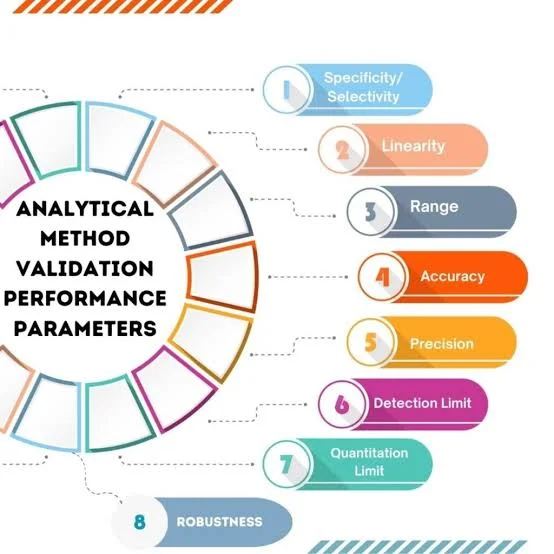
Important Assay Method Validation Parameters
The commonly evaluated parameters for an assay method include:
- Specificity
- Accuracy
- Precision
- Linearity
- Range
- Robustness
- Solution stability
- System suitability
- Filter compatibility, where applicable
Not every parameter has exactly the same relevance for every analytical procedure. The validation protocol should be scientifically justified according to the method’s intended purpose.
1. Specificity
Specificity demonstrates that the analytical procedure can measure the API accurately in the presence of other components that may be present in the sample.
For a drug product, potential interfering components may include:
- Excipients
- Degradation products
- Process impurities
- Placebo components
- Other APIs in combination products
HPLC Assay Example
Suppose an HPLC assay method is developed for an API in tablets.
The following solutions may be analyzed:
- Diluent
- Blank
- Placebo
- Standard
- Sample
- Spiked sample
- Forced degradation samples, where appropriate
The API peak should be adequately separated from interfering peaks.
For example: API retention time = 8.5 minutes
If the placebo does not show any significant peak at the API retention time, this supports the specificity of the method.
Specificity is particularly important when the product contains multiple components or when degradation products could potentially interfere with the assay.
2. Accuracy
Accuracy describes how close the measured result is to the true or accepted reference value.
For an assay method, accuracy is commonly evaluated through recovery studies using placebo spiked with known quantities of API.
For example, recovery may be evaluated at:
- 80%
- 100%
- 120%
or another scientifically justified range.
Suppose the theoretical amount added is 100 mg and the measured amount is 99.2 mg.
Recovery is: Recovery (%) = Measured amount / Added amount × 100
= 99.2 / 100 × 100
= 99.2%
If the predefined acceptance criterion is, for example, 98.0–102.0%, this result passes.
Important Point
There is no universal rule that every assay method must have exactly 98–102% recovery. Acceptance criteria should be established based on the method, product, concentration, and intended use.
3. Precision
Precision evaluates the closeness of agreement between individual measurements.
It is generally considered at different levels.
Repeatability
Repeatability evaluates precision under the same operating conditions over a short period.
For example, six independent sample preparations may be analyzed.
Suppose the assay results are:
- 99.4%
- 99.7%
- 100.1%
- 99.8%
- 99.5%
- 99.9%
The %RSD of the six results is calculated.
A low %RSD indicates good repeatability.
Intermediate Precision
Intermediate precision evaluates the effect of normal variations within the laboratory, such as:
- Different analyst
- Different day
- Different instrument
- Different column, where appropriate
The purpose is to demonstrate that the method remains precise under normal laboratory conditions.
4. Linearity
Linearity demonstrates whether the analytical response is proportional to the concentration of analyte within the selected range.
For an assay method, a typical study could include concentrations such as:
50%, 75%, 100%, 125%, and 150%
depending on the intended range.
A calibration plot is prepared:
Concentration vs. Response
For HPLC, the response is commonly represented by peak area.
A regression equation is generated:
y = mx + c
where:
- y = detector response
- x = concentration
- m = slope
- c = intercept
The correlation coefficient or other suitable regression statistics are evaluated.
However, simply obtaining a high correlation coefficient does not by itself prove linearity. The regression model and residuals should also be scientifically assessed.
5. Range
Range is the interval between the lowest and highest concentrations for which the method has demonstrated suitable performance.
For example, if the method is validated from 80% to 120% of the target concentration, this may be established as the validated range when supported by acceptable accuracy, precision, and linearity.
The selected range should cover the method’s intended application.
For an assay method, the range is generally centered around the nominal sample concentration.
6. Robustness
Robustness demonstrates the ability of the method to remain reliable when small deliberate variations are introduced into analytical conditions.
For an HPLC assay method, possible variables include:
- Mobile phase composition
- Flow rate
- Column temperature
- pH
- Buffer concentration
- Different column lots, where relevant
Example
Suppose the method uses:
Flow rate = 1.0 mL/min
During robustness testing, the flow rate may be deliberately changed to:
- 0.9 mL/min
- 1.1 mL/min
The effect on assay, retention time, resolution, and system suitability is evaluated.
Similarly, a small change in mobile-phase composition can be investigated.
The objective is not to prove that the method gives exactly the same result under every condition. The objective is to understand whether reasonable variations could affect the method’s performance and whether the proposed method has adequate control.
7. Solution Stability
Solution stability is important because HPLC samples and standards may remain in the autosampler or laboratory for several hours before analysis.
For example, the standard and sample solutions can be evaluated at:
- Initial
- 12 hours
- 24 hours
under defined storage conditions.
The results are compared with the initial result.
If the solution shows significant degradation or concentration change, the sample solution holding time should be reduced or suitable storage conditions should be established.
Solution stability can be particularly important when:
- The API is unstable in the diluent.
- The sample contains a complex matrix.
- The method requires long analytical sequences.
- The sample is sensitive to light or temperature.
8. System Suitability
System suitability is an important part of routine chromatographic analysis.
It confirms that the chromatographic system is performing adequately before or during sample analysis.
Typical parameters may include:
- %RSD of standard injections
- Tailing factor
- Theoretical plates
- Resolution, where applicable
For example, a method may specify:
Standard peak area %RSD: NMT 2.0%
The exact acceptance criteria should be scientifically justified and defined in the analytical procedure.
System suitability is not a replacement for method validation. Validation demonstrates that the method is fit for purpose, while system suitability checks whether the system is performing acceptably during routine analysis.
Assay Method Validation Example
Let’s consider a hypothetical HPLC assay method for a 100 mg tablet.
Sample Preparation
Suppose:
- 20 tablets are weighed.
- Tablets are powdered.
- An accurately weighed quantity equivalent to 100 mg API is transferred to a volumetric flask.
- Diluent is added.
- The sample is sonicated and diluted to volume.
- The solution is filtered before injection.
A reference standard is prepared separately at approximately the same concentration.
The sample and standard are injected into the HPLC system.
Suppose:
Standard peak area = 1,000,000
Sample peak area = 998,000
Assume all other correction factors are 1.000 for simplicity.
The basic assay calculation can be represented as:
Assay (%) = Sample response / Standard response × Standard concentration / Sample concentration × Standard potency × 100
If the standard and sample concentrations are identical and the standard potency is 99.5%:
Assay:
= 998,000 / 1,000,000 × 99.5
= 99.30%
Therefore, the calculated assay is approximately 99.3%.
This example is simplified. Actual pharmaceutical assay calculations may include sample weight, average weight, dilution factors, potency on an appropriate basis, moisture/water correction, molecular-weight conversion, and other applicable factors.
Typical Assay Validation Summary
A validation protocol may be structured like this:
| Parameter | Purpose |
|---|---|
| Specificity | Demonstrate absence of interference |
| Accuracy | Demonstrate closeness to true value |
| Repeatability | Demonstrate method precision |
| Intermediate precision | Demonstrate reproducibility within the laboratory |
| Linearity | Demonstrate proportional response |
| Range | Establish suitable concentration interval |
| Robustness | Evaluate effect of deliberate variations |
| Solution stability | Establish sample/standard holding time |
| System suitability | Confirm chromatographic system performance |
The actual acceptance criteria should be scientifically justified and predefined in the validation protocol.
Common Mistakes During Assay Method Validation
Several problems can occur during assay validation.
1. Poor Sample Preparation
Incomplete extraction can result in low assay recovery.
For example, an API may not completely dissolve or extract from a tablet matrix.
2. Incorrect Diluent Selection
A poor diluent can cause:
- Precipitation
- Adsorption
- Poor peak shape
- Incomplete extraction
- Solution instability
3. Ignoring Placebo Interference
A placebo peak close to the API peak can affect the assay result.
4. Excessive Reliance on Correlation Coefficient
A high R² alone does not establish that the method is suitable.
5. Poor Robustness Design
Changing multiple chromatographic parameters simultaneously can make it difficult to identify which parameter caused an observed effect.
6. Inadequate Solution Stability Study
If routine sequences require 18 hours of analysis but only 6-hour solution stability is demonstrated, the established holding time may not adequately support the intended procedure.
Assay Method Validation vs Assay Method Verification
These terms are sometimes confused.
Validation is used to establish that a newly developed or appropriately modified analytical procedure is fit for its intended purpose.
Verification is generally used when an established compendial procedure is implemented in a particular laboratory to demonstrate that the procedure performs as required under the laboratory’s conditions.
The exact approach depends on the analytical procedure, pharmacopoeial requirements, and regulatory expectations.
Regulatory Perspective
Assay validation should be performed according to the applicable regulatory and compendial framework.
The current ICH approach to analytical procedure validation is described in ICH Q2(R2), which provides a framework for demonstrating that analytical procedures are fit for their intended purpose.
Pharmacopoeial methods may also have specific requirements for their use and verification.
Therefore, a good validation strategy should consider:
- Intended purpose of the method
- Product characteristics
- Analytical technology
- Applicable pharmacopoeia
- Regulatory requirements
- Method lifecycle stage
- Existing scientific knowledge
Assay method validation is a critical part of pharmaceutical analytical development and quality control. A validated assay method should provide reliable and scientifically justified results throughout its intended application.
The most important parameters commonly considered for an assay method are specificity, accuracy, precision, linearity, range, robustness, and solution stability, along with appropriate system suitability requirements for chromatographic methods.
The key principle is simple: validation should demonstrate that the analytical procedure is fit for its intended purpose—not merely that it produces acceptable numbers.
Frequently ask FAQ
1. What is assay method validation?
It is the documented demonstration that an assay procedure is suitable for its intended purpose.
2. What are the main assay validation parameters?
Specificity, accuracy, precision, linearity, range, and robustness are the major parameters, with other studies considered as appropriate.
3. What is assay accuracy?
Accuracy indicates how close the measured result is to the true or accepted reference value.
4. What is assay precision?
Precision describes the closeness of agreement among repeated measurements.
5. What is assay linearity?
Linearity demonstrates that analytical response is proportional to analyte concentration over a defined range.
6. What is assay robustness?
Robustness evaluates the method’s ability to remain reliable after small deliberate changes in analytical conditions.
7. Why is specificity important in an assay method?
It ensures that other sample components do not interfere with measurement of the API.
8. Is system suitability a validation parameter?
System suitability is a routine performance check and supports chromatographic analysis; it is not a substitute for method validation.
9. What is the typical assay validation range?
The range should be scientifically justified based on the intended use and demonstrated method performance.
10. Which guideline is used for analytical method validation?
ICH Q2(R2) is the current ICH guideline addressing validation of analytical procedures.