

What is an HPLC Column: HPLC Column Types
Introduction:
HPLC Column Types An HPLC column is a stainless steel or peek tube packed with stationary phase particles. When a liquid mobile phase carries a sample through the column, compounds interact differently with the stationary phase, leading to separation.
Every HPLC column is defined by: (Stationary phase chemistry, Particle size, Column length, inner diameter and pore size)
Understanding these parameters is essential for method development and optimization.
Why HPLC Column Type Matters
Different compounds behave differently under chromatographic conditions. A column that works perfectly for small organic molecules may fail completely for proteins or ionic compounds. That’s why HPLC columns are available in multiple types, each designed for specific separation mechanisms.
Selecting the correct HPLC column improves: (Resolution, Analysis time, Sensitivity and Column life)
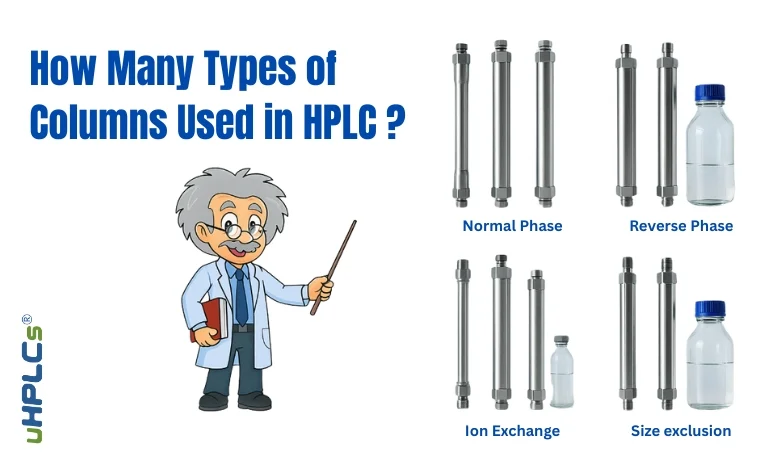
Common HPLC Column Types
1. Reversed-Phase HPLC Columns (Non-polar stationary phase and Polar mobile phase)
Reversed-phase columns are the most widely used HPLC column type, accounting for over 70% of all applications.
Common chemistries: (C18-ODS, C8, Phenyl and CN-Cyano)
Generally reversed phase HPLC column used for Pharmaceuticals, Peptides, Food analysis and Environmental sample analysis.
C18 columns are often the first choice due to their strong retention and versatility
2. Normal-Phase HPLC Columns (Polar stationary phase and Non-polar mobile phase)
Common stationary phases: (Silica, Amino and Diol column)
Generally normal phase HPLC column used for Lipid, Isomers and Non-polar compounds analysis.
While less common today, normal-phase HPLC is still valuable for specific separations.
3. Ion-Exchange HPLC Columns
Ion-exchange columns separate compounds based on charge interactions.
Two types of ion cation and Anion exchange column used in Ion-Exchange analysis
These columns are essential in biopharmaceutical and biochemical analysis.
4. Size Exclusion (SEC/GPC) Columns (No adsorption, Gentle separation)
Size exclusion chromatography separates molecules based on molecular size, not chemical interaction.
Size Exclusion column used for Proteins, Polymers and Aggregation study.
SEC columns are ideal when preserving molecular structure is critical.
5. Chiral HPLC Columns (separate enantiomers molecules)
Chiral columns are designed to separate enantiomers molecules that are mirror images of each other.
These columns play a vital role in ensuring drug safety and regulatory compliance.
Understanding HPLC Column Dimensions:
HPLC column dimension: Column dimensions directly affect resolution, speed, and solvent consumption.
HPLC column dimension is expressed as: Length × Internal Diameter (ID)
HPLC Column Length:
HPLC Column length range is 30mm, 50mm, 100mm, 150mm, 200mm, 250mm and 300mm
HPLC Column length: i) Longer Column for better resolution
i) Longer Column for better resolution
ii) Shorter Column for Faster analysis
HPLC Column Internal Diameter (ID)
HPLC column Inner diameter: 4.6mm (most column), 3.0mm, 2.1mm (For UHPLC)
Smaller diameter reduces solvent usage and improve sensitivity but require more precise instrumentation.
HPLC Column Particle Size and its Role: (2.7µm, 3.0µm and 5µm generally used)
Smaller particles provide higher efficiency but generate higher backpressure.
How to Choose the Right HPLC Column
When selecting an HPLC column, consider the following:
- Sample chemistry – polar, non-polar, ionic, or chiral
- HPLC column length – balance resolution vs. runtime
- HPLC column dimension – match system pressure limits
- Detector sensitivity
For method transfer, always keep column dimensions consistent to avoid unexpected changes in retention time.
HPLC Column Dimensions and Method Development
During method development, adjusting the HPLC column length or internal diameter can significantly improve results.
You can use switching from 250 mm to 150 mm can cut runtime by 40%
You can reduce ID from 4.6 mm to 2.1 mm saves solvent and increases sensitivity
However, any change in HPLC column dimension requires recalibration and validation.
Maintenance HPLC Column Life
Use inline filters to prevent contamination, match pH limit to column chemistry and store column in recommended solvent mention in column COA provide by vendor, this step follow to increase column life during analysis.
Final Thoughts
Understanding HPLC column types, HPLC column dimensions, and HPLC column length is essential for anyone working with liquid chromatography. The right column doesn’t just improve separation it saves time, reduces costs, and ensures reliable data.
Whether you’re developing a new analytical method or optimizing an existing one, choosing the correct HPLC column is a decision that deserves careful thought. With the right knowledge, you can confidently select a column that delivers accurate, reproducible, and high-quality results.
Top FAQs on HPLC Column Types and Uses
-
What is an HPLC column?
An HPLC column is a packed tube used in High-Performance Liquid Chromatography to separate compounds in a mixture. -
What is the main function of an HPLC column?
The main function of an HPLC column is to separate different chemical components based on their interaction with the stationary phase. -
Which HPLC column is most commonly used?
The C18 reverse-phase column is the most commonly used HPLC column in pharmaceutical analysis. -
What are the main types of HPLC columns?
The main types include reverse phase, normal phase, ion exchange, size exclusion, and chiral columns. -
Why is C18 column widely used in HPLC?
The C18 column is widely used because it provides strong hydrophobic interactions and excellent separation for many compounds. -
How long does an HPLC column last?
An HPLC column typically lasts several hundred injections depending on sample type and maintenance. -
What affects HPLC column performance?
Column performance is affected by factors such as particle size, mobile phase composition, temperature, and flow rate. -
How should an HPLC column be stored?
An HPLC column should be stored in a suitable solvent like methanol or acetonitrile to maintain its performance.
Great 👍
Good information
Greatly explained….!!!
Nice